
The data centre question is capacity
What the numbers say about data centre capacity, and where ION fits in.
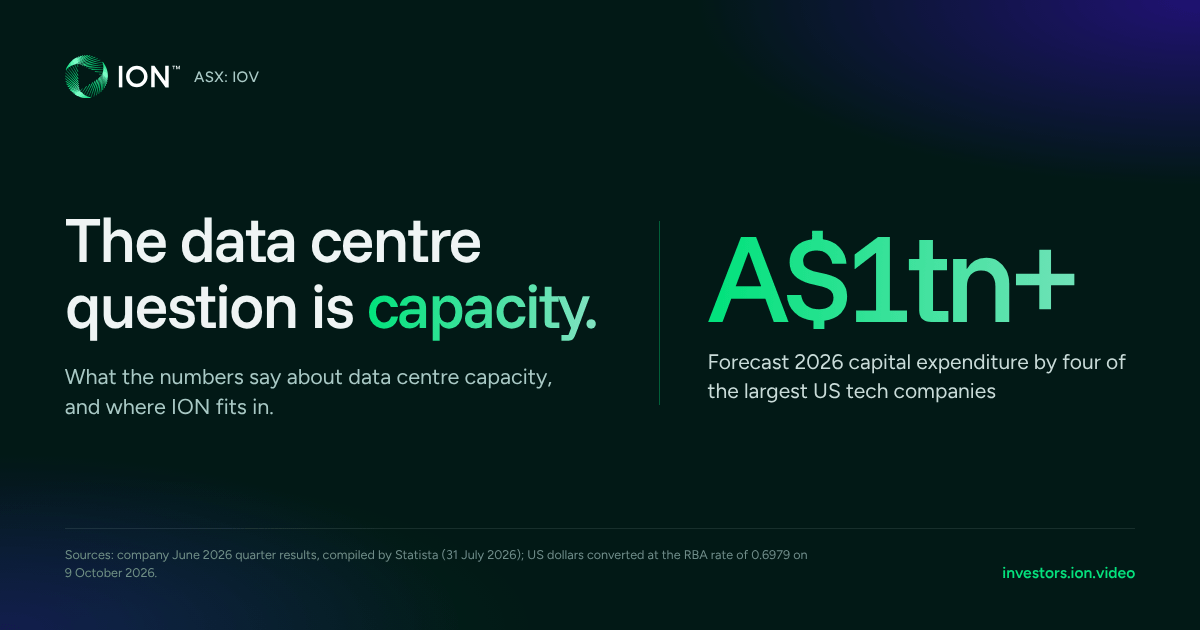
Four of the largest US tech companies expect to spend more than A$1 trillion on capital expenditure this year as they build out AI infrastructure. In Australia, AEMO forecasts that data centres will use about 13% of the electricity on the main grid by 2035-36, up from about 3% in 2025-26.
Every new cut, audience or context of an existing video usually means another version that has to be rendered, moved, stored and governed. Each of those versions takes processing to make and storage to keep. ION maps a video once and assembles it at every play, working from a map measured in kilobytes where the original runs to gigabytes. Each version is resolved from that one master at the moment of play, so nothing new is rendered and ION does not need to create and store another complete video file for every new version. AI can assemble video from what already exists instead of generating it.
In its June investor presentation, ION described a thousand viewers each receiving a unique version of a video without a single new file being rendered. The architecture that makes this possible sits on protected ground, covered by ION's granted patents.
For data centre operators, JLL forecasts that the average global cost of building one megawatt of capacity will rise 6% in 2026 to about A$16.2 million. ION's commercial focus is on increasing productive capacity from infrastructure they have already invested billions in, reducing the processing and storage costs associated with video workloads, and creating opportunities for new video services and revenue streams.
ION's validation program will measure what this means in practice. Two of the six problems it will test relate directly to it, namely data centre power and infrastructure cost, and AI models assembling video from existing footage instead of generating it. The first claim on the program's list is that video which never renders is compute never spent. Each trial will run in a partner's own operating environment, with an independent partner designing it, measuring the result and reporting the findings.